Overview
The first 90 days with a social media marketing agency build a strategic foundation through onboarding, execution, and optimization, driving measurable growth like higher engagement, traffic, and ROI through data-driven campaigns and structured planning.
The first 90 days with a social media marketing agency represent a critical growth period that establishes the strategic foundation for long-term digital success. Understanding what to expect during the first 90 days with a social media marketing agency helps businesses set realistic goals, align expectations, and maximize campaign performance.
According to a 2025 HubSpot report, businesses working with social media marketing agencies see an average 23% increase in engagement rates within 90 days. However, success depends on structured planning, with the first 2–4 weeks focused on strategy, the next 4 weeks on execution, and measurable growth such as a 15–30% traffic increase often appearing by day 90.
This article breaks down what to expect during 90 days with a social media marketing agency through three essential phases to provide clear, actionable expectations.
Days 1–30: Onboarding, Research, and Strategic Foundation
The first 30 days focus on building a strong foundation through business discovery, performance audits, competitor research, and strategic planning to ensure future social media efforts are data-driven and aligned with long-term goals.
Agency Onboarding and Business Discovery
During the first month, social media marketing agencies secure access to platforms like Instagram, Facebook, LinkedIn, and analytics tools while aligning with your business goals, such as lead generation, brand awareness, or customer engagement. Reviewing past performance is essential, as audits of 3–12 months of social data reveal profile inconsistencies in nearly 70% of businesses.
For example, if a company’s Instagram posts have inconsistent branding or low engagement, the agency can identify these issues early and create a more unified strategy.
Social Media Audit and Competitor Analysis
Agencies assess your current social media presence against industry benchmarks. In 2025, Instagram engagement averages 0.45–0.6%, while LinkedIn averages 3–3.5%, according to Adobe Express. Competitor analysis tools like Hootsuite help uncover content gaps, platform opportunities, and audience behavior trends.
For instance, if competitors are gaining stronger reach through TikTok’s higher 2.5% engagement rates or Instagram Reels’ 30.81% non-follower reach, agencies may recommend shifting more content toward short-form video.
Goal Setting and KPI Development
During this stage, agencies establish SMART (Specific, Measurable, Achievable, Relevant, and Time-bound) KPIs (Key Performance Indicators) to guide campaign performance.
Common goals may include achieving 10–20% follower growth, improving engagement rates by 1–3%, increasing website traffic, or generating more qualified leads. By setting clear and measurable objectives early, businesses can maintain focused strategies that often result in 2–4x stronger ROI (Return on Investment) potential through better performance tracking and optimization.
Strategy Development
The agency then builds a customized strategy that includes content pillars, visual branding, posting frequency, and campaign structure. Most brands benefit from posting 3–5 times weekly, as consistent posting can double growth compared to irregular schedules.
For example, agencies like Sigil prioritize strategic storytelling, creative branding, and conversion-focused content calendars to help brands scale audience trust while driving measurable business growth. This structured foundation ensures campaigns launch with clarity rather than guesswork.
Days 31–60: Content Deployment and Active Campaign Management
This phase is where strategy turns into execution. Content goes live consistently, paid campaigns begin testing, and audience engagement becomes active—allowing the agency to gather real performance data and refine direction.
Content Publishing Begins
Content becomes consistent and tailored per platform—Instagram for visuals and short-form video, and LinkedIn for thought leadership and B2B positioning. A structured schedule of 3–5 posts per week helps maintain visibility and algorithm performance.
For example, a real estate company may post property tours and listings on Instagram Reels and Facebook, while using LinkedIn for market insights and investment updates.
Strong branding, storytelling captions, and clear CTAs like “Book a viewing” help turn engagement into inquiries and conversions. Regular posting also improves visibility and steadily enhances overall engagement performance, allowing content to reach and resonate with a wider audience.
Paid Campaign Launch
Once organic content is stable, paid advertising is introduced to accelerate reach and lead generation. Initial budgets typically range from $500–$2,000 per month, depending on business size and goals.
Campaigns are structured around:
- Audience targeting (age, location, interests, behaviors)
- A/B testing of 3–5 ad creatives
- Multiple formats (carousel ads, video ads, lead forms)
For instance, a waste management or sanitation services company may test different ad variations to improve lead generation and efficiency.
- Ad A: Service explanation with compliance benefits
- Ad B: Customer testimonial on reliability
- Ad C: Limited-time offer or free site inspection
By comparing results, the campaign identifies what drives the most inquiries. With optimized targeting and testing, this type of campaign can achieve up to 4.2x ROAS (Return on Ad Spend).
Community Building and Audience Engagement
Beyond posting and ads, community management becomes a key focus, with agencies handling comments, direct messages, and inquiries to build trust and strengthen brand relationships.
On average, agencies manage 70–80% of daily social interactions, and active engagement can boost audience growth by up to 28% (Sprout Social).
For example, a simple query like “How long does delivery take?” is promptly addressed with a clear, helpful response—reinforcing reliability and encouraging conversion.
This stage shifts social media from one-way promotion to a responsive, two-way communication channel.
Early Performance Monitoring
Real-time analytics guide decision-making at this stage, with agencies tracking dashboards to identify what performs well and what needs improvement.
Key metrics include:
- Impressions (target: 100,000+ for growing campaigns)
- Click-through rate (CTR) (benchmark: 1–2%)
- Engagement rate (likes, shares, comments)
- Conversions (leads, sign-ups, purchases)
For example, if Instagram Reels generate 20%+ higher performance than static posts, more focus is shifted to short-form video. Underperforming ads are paused or refined to improve efficiency.
Days 61–90: Optimization, Scaling, and Performance Refinement
This stage focuses on turning performance data into stronger results by refining strategy, scaling winning campaigns, and improving overall efficiency.
Strategy Refinement Based on Data
High-performing content is scaled by increasing investment in ads with strong click-through rates, while underperforming campaigns are paused or restructured. Targeting is further improved using lookalike audiences, increasing efficiency by up to 35% based on Google Ads benchmarks.
ROI and Lead Generation Focus
The focus shifts from engagement to conversions, with funnel optimization aimed at improving lead and sales performance by 15–25%. Successful campaigns are often scaled 2–3x, prioritizing revenue-driven outcomes over vanity metrics.
Reporting and Strategic Review
A full 90-day report evaluates KPI performance against initial goals, highlighting key wins, gaps, and opportunities for improvement with clear, data-backed insights.
Long-Term Planning
Automated content systems and evergreen strategies are implemented to sustain momentum and support future campaigns.
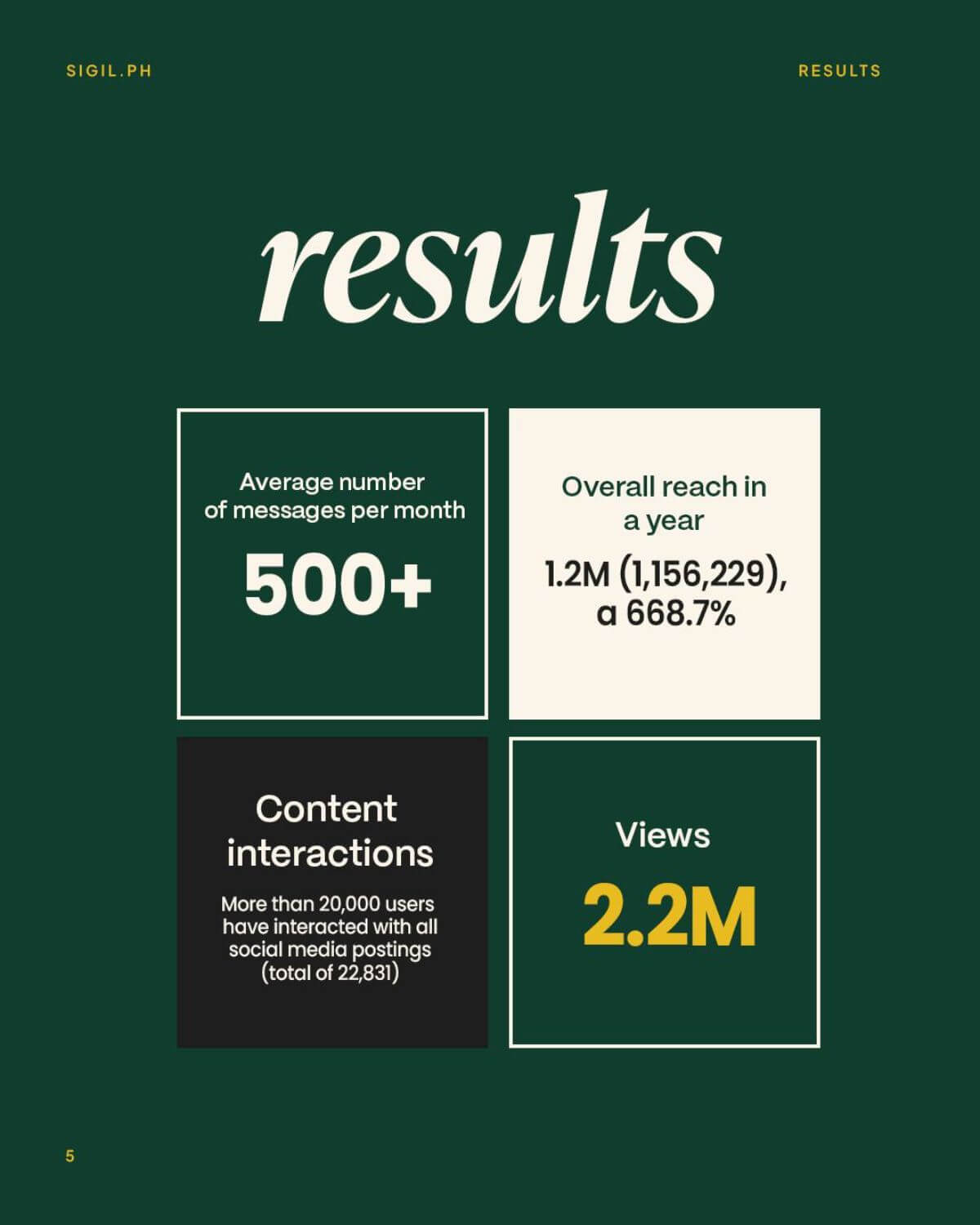
At Sigil, this phase is where early campaign insights are translated into scalable systems that strengthen long-term brand performance and sustainable business growth.
Why Choose Sigil for Social Media Marketing in the Philippines
At Sigil, we are a social media marketing agency based in the Philippines, working with both local and international brands across a wide range of industries—from retail, real estate, healthcare, and hospitality to B2B services, manufacturing, education, and e-commerce.
We focus on building performance-driven strategies that turn social media into a consistent source of visibility, engagement, and conversions.
What Sets Us Apart
| Area | What We Do |
|---|---|
| Fast Onboarding | Strategy setup, audits, and account access completed within 2–4 weeks |
| Strategy Approach | Data-driven campaigns tailored to audience behavior and business type |
| Execution Focus | Optimized for engagement, leads, conversions, and ROI—not vanity metrics |
| Reporting | Clear, structured performance reports with actionable insights |
| Results Timeline | Engagement growth within 30 days; scalable ROI improvements by Day 90 through continuous optimization |
Key Takeaway
Understanding what to expect during the first 90 days with a social media marketing agency is essential for setting realistic goals and achieving sustainable growth.
Ready to elevate your social media presence? Partner with Sigil to implement a structured 90-day strategy designed to deliver scalable, results-driven outcomes for your business.